Start with the job, then the mechanism
In a plant-upgrade story, the word valve can cover several different jobs. These three examples give a reader a useful first distinction. They do not determine what equipment a facility should install.
| Example | Role to recognize | Mechanical idea |
|---|---|---|
| Globe-style control valve | Adjust an opening as part of process control | A plug moves relative to a seat |
| Gate valve | On/off service | A gate moves across or out of the passage |
| Ordinary swing-check valve | Limit reverse flow | A hinged disc responds to the fluid conditions |
Emerson describes the translating closure and actuator relationship in a globe control valve. SLB describes the gate's on/off role and the check valve's one-way role. Check designs vary, including versions with additional external control; the ordinary swing example above is not every check valve. Emerson: globe control valves, SLB: gate valves, SLB: check valves.
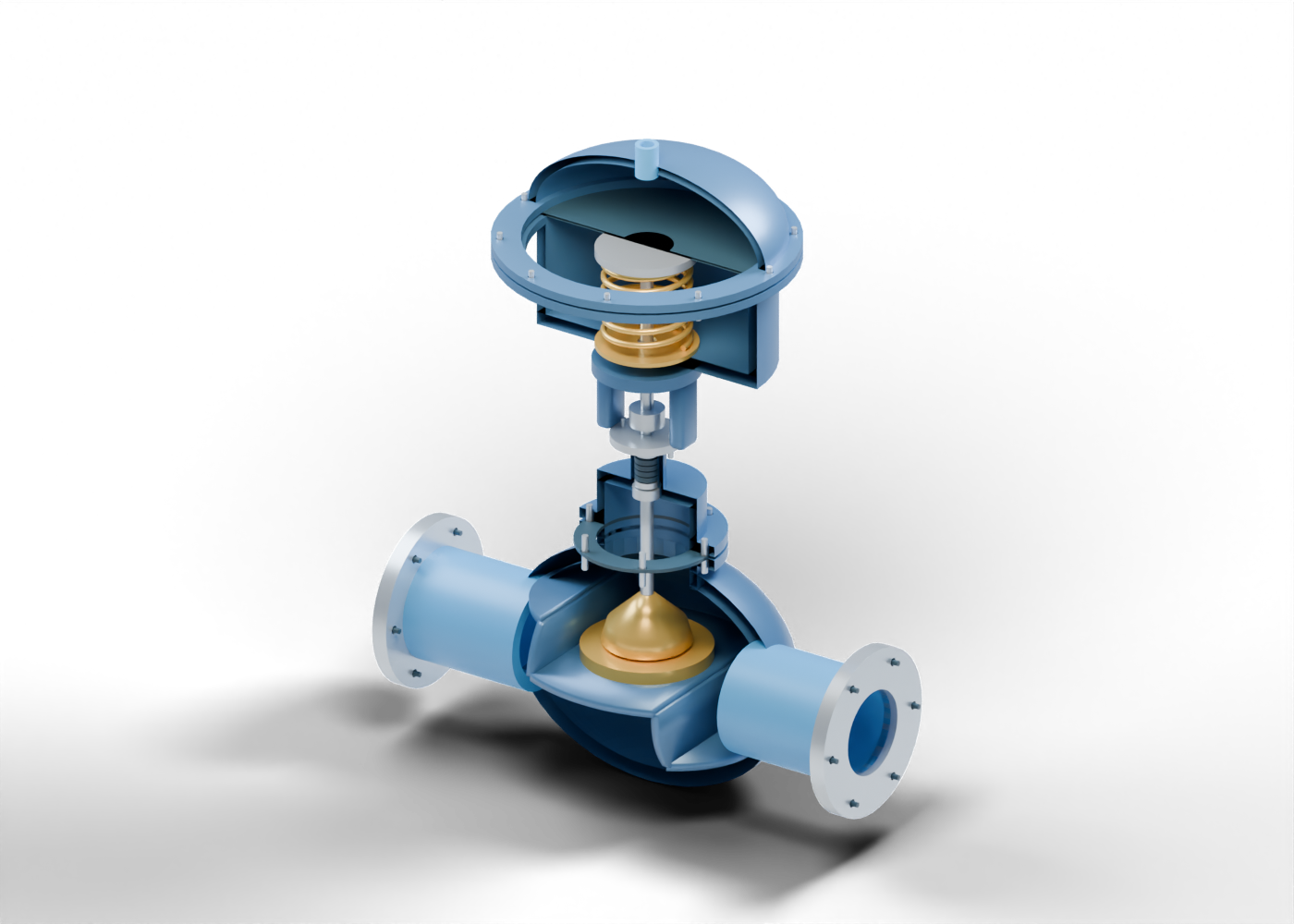
Read the original globe-valve cutaway
Our 74-part teaching assembly has two process connections and a stepped internal chamber. The gold plug sits above a separate annular seat. A smooth stem extends through a bonnet and a stack of four packing-ring markers. Farther up, a connector joins the valve stem to the actuator stem and a rigid plate beneath the diaphragm.
Follow that line from bottom to top. The plug, stems, connector and plate form one connected moving group in the 3D illustration. The surrounding body, packing housing and actuator casing remain separate objects. The section removes part of the enclosure for visibility; it does not show equipment opened for work.
The diaphragm is a thin flexible marker clamped around its rim. Its centre follows the rigid plate, while the outer rim stays fixed. A continuous spring marker sits below the plate. Our slider changes these shapes together, using invented travel and deformation. It calculates no air pressure, spring force, material strain or fluid movement. Colours distinguish parts rather than a standard piping or safety classification.
Separate the actuator from the control loop
An actuator provides movement at the valve. A positioner can use a requested signal and position feedback to help bring the valve to the requested position. That is distinct from knowing the actual process condition being controlled. Spirax Sarco explains these relationships in its steam education material. Spirax Sarco: actuators and positioners.
Our illustration includes an air tapping but omits a positioner, controller, sensors, air preparation and exhaust arrangements. The pictured spring does not establish a verified failure position. A stem raised halfway in the viewer also does not mean half the process flow: the illustration has no measured valve characteristic or flow calculation.
Ask what the headline actually proves
When a report describes an automated valve, control upgrade or reliability project, ask:
- Which function is changing: control, isolation, backflow prevention or another role?
- Does the evidence identify only the valve, its actuator, or the wider control system?
- Is the reported result a position command, measured position, measured process value or design target?
- Does the claimed reliability result identify conditions, period and supporting records?
- Does the illustration represent the actual installation or a generic teaching concept?
An equipment category alone does not establish a pressure rating, leakage performance, approved service or safe installation. This explainer contains no selection, operating or maintenance procedure.
Inspect the 3D companions
These 3D models let you select individual parts and compare their invented mechanisms: globe control valve, gate valve and swing-check valve. These are original educational models with no manufacturer affiliation or endorsement.