1. Locate the mist-elimination step
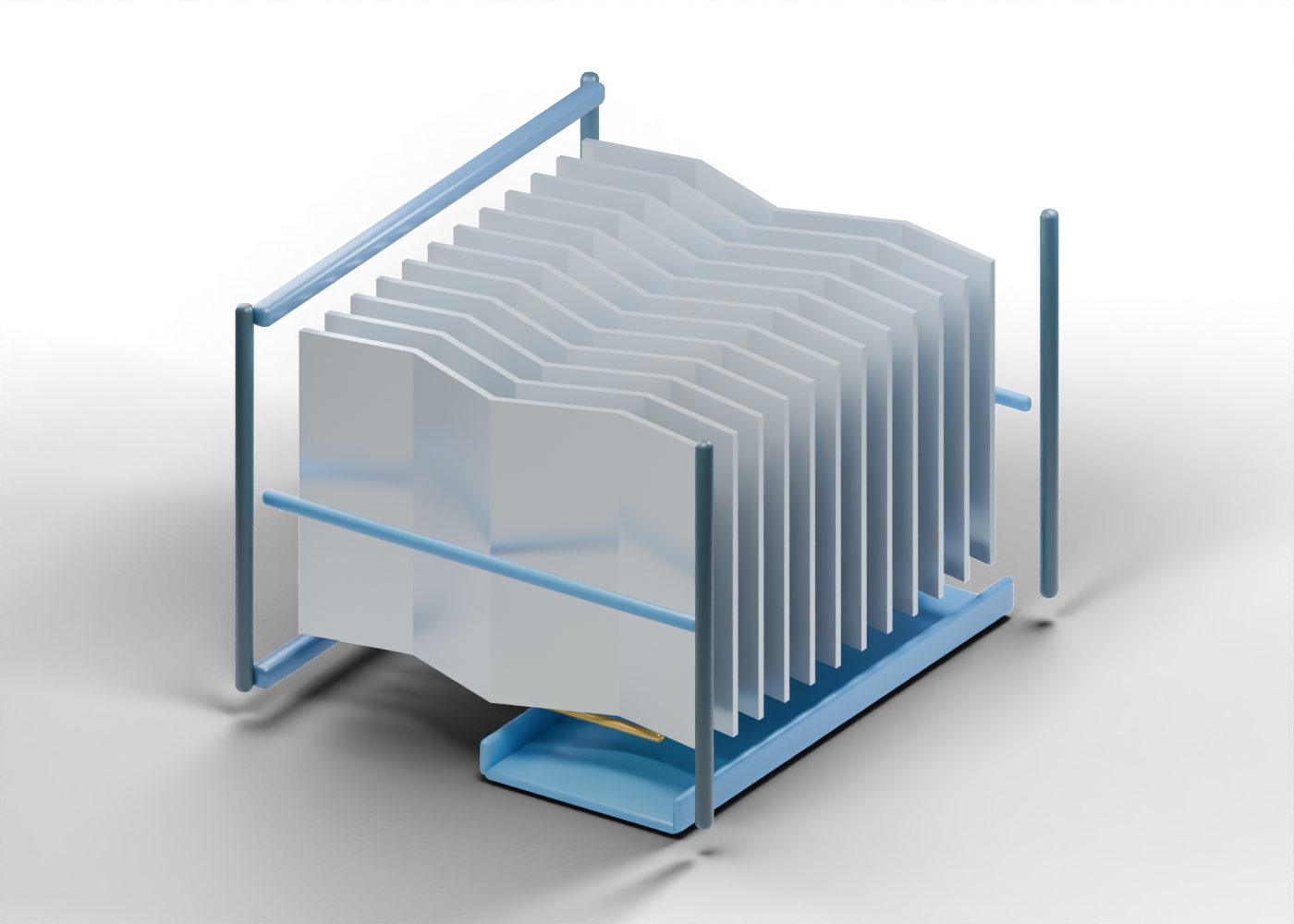
A gas stream leaving a separator can still carry small liquid droplets. Mist-elimination internals are one way to address that carryover. Koch-Glitsch's mist-elimination overview distinguishes vane, mesh and other equipment families; it does not make them interchangeable. Our original 35-part chevron model is a generic close-up of one possible vane-pack arrangement, not a selected product, complete vessel or performance simulation.
2. Look into the open passages
The model has twelve separate solid plates. Compare chevron vane 1 with chevron vane 6 and chevron vane 7. Their invented kinked paths leave actual open spaces between neighbours. A change in gas direction can bring entrained droplets toward a surface, but the drawing does not show an actual flow field or prove contact, coalescence or separation.
3. Keep drainage distinct from gas passage
The gold lower drainage lip at vane 6 is separate from its silver vane. The open trough floor, inlet rim and outlet rim mark a lower collection region. None connects to a real vessel drain. Liquid loading, re-entrainment and carryover are equipment-specific questions that this static geometry cannot answer.
4. Inspect the frame without assuming fit
The left side guide, right side guide and upper cross rail are independently selectable. They show where a module boundary might be discussed, not how an internal is supported or sealed in a particular vessel. The invented pitch, profile and material do not match a manufacturer's design.
5. Read the model alongside other separator internals
Compare this close-up with AlbertaOil's vertical two-phase separator and gas-liquid coalescer. Those are separate generic teaching assemblies. They do not form a common Alberta plant, and a vessel's mist-control selection depends on its actual service. A mesh pad and a chevron pack are different physical arrangements, with different design questions.
| Visible feature | Useful reading question | Not established |
|---|---|---|
| Independent kinked vanes | Where are the open passages? | Gas velocity or flow pattern |
| Thin solid plates | Where could droplet contact occur? | Capture efficiency or droplet cut size |
| Separate lower lips | Where might liquid be led downward? | Drainage rate or re-entrainment limit |
| Open lower trough | Where is a collection region shown? | Real vessel drain connection |
| Open frame | What bounds the module? | Mounting load or service fit |
6. Check a real performance claim
If a news release says a separator upgrade reduced carryover, look for the actual equipment, service conditions, measurement method and before-and-after evidence. The interactive vane-pack lesson can help identify parts, but it cannot verify the claim. Do not infer pressure drop, removal efficiency, cleaning intervals or vessel access requirements from an illustration.