1. Start with the water question
Produced water can retain free oil and suspended solids after an earlier separation step. A nutshell-media filter is one possible polishing role; it is not a universal final step. Veolia's nutshell-filter overview describes water passing down through a media bed, while SLB's walnut-shell-filter overview describes removal of oil and suspended solids from produced water. Neither source qualifies our invented model.
The earlier AlbertaOil hydrocyclone lesson explores a different possible water-treatment role. The scenes are independent: there is no selected pipeline, flow, pressure, feed condition or guaranteed sequence between them.
2. Open the original vessel
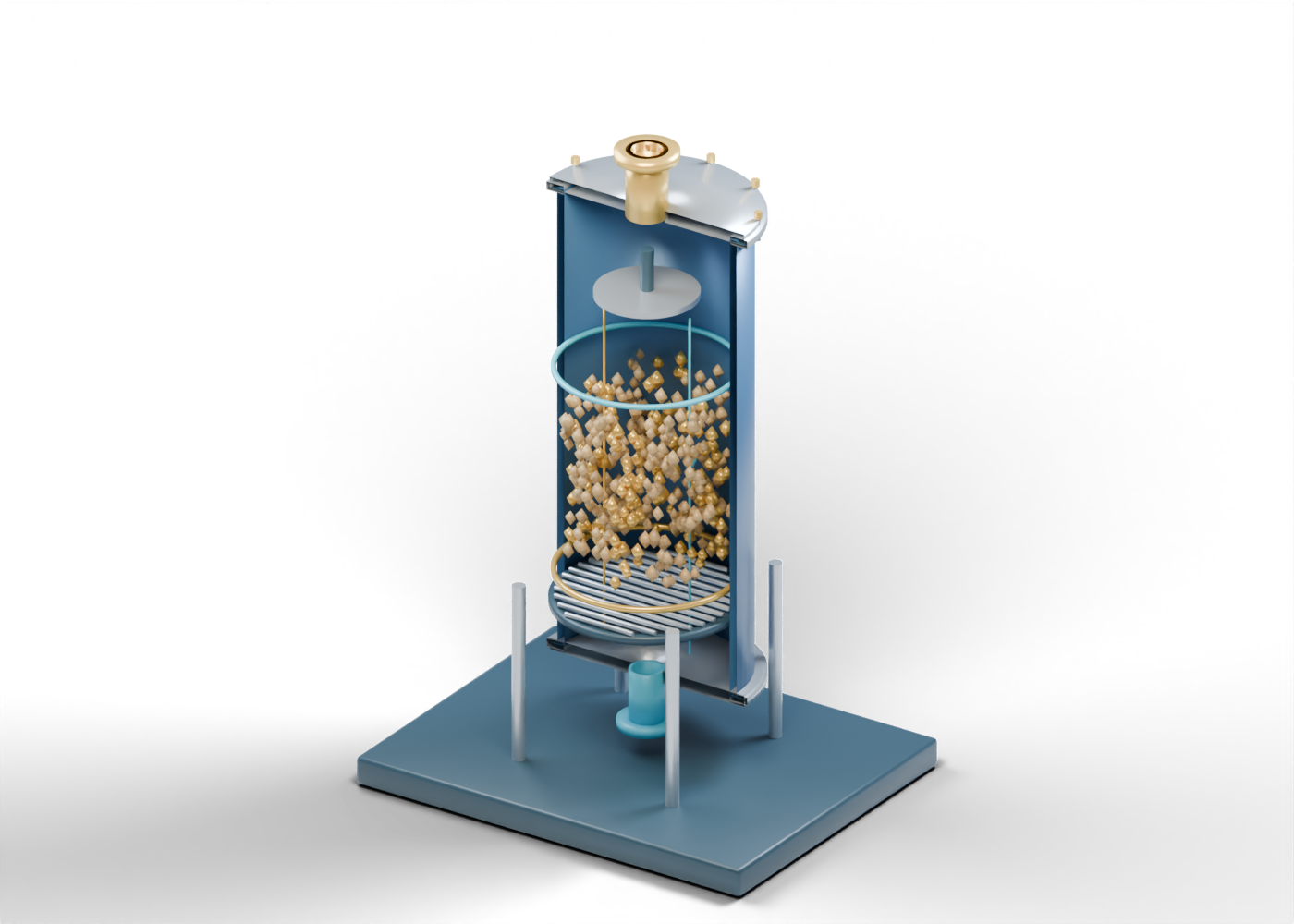
The complete hollow filter vessel wall has a separate top feed passage and lower outlet passage. Only the poster cuts the facing wall. In the interactive model, Reveal internals makes the full enclosure inspectable. The deflection marker and supports are invented teaching shapes, not a supplier's distributor or a pressure-rated installation.
3. Read the bed without assuming performance
The illustration groups 456 simple grain shapes into twelve selectable sectors. One media sector locates the conceptual bed. Real media selection depends on its properties, feed contaminants, filtration rate, vessel configuration and operating controls. The blue service-downflow cue is a fixed line through the illustrated bed, not a measured path or proof of oil removal.
4. Follow the lower boundary
The open-slot underdrain rail is one of thirteen separate bars above the lower collection space. Its visible gaps distinguish the bed from the outlet region; they are not a selected screen or hydraulic design. The lower outlet is labelled polished water to explain the role, but neither the model nor the name establishes an outlet concentration, injection suitability, reuse quality or discharge authorization.
| Illustrated element | What it identifies | What it cannot prove |
|---|---|---|
| Top feed | An incoming water boundary | Selected pressure or feed composition |
| Sparse grain sectors | A media-bed role | Real packing, grade or capture efficiency |
| Blue downflow cue | A possible service direction | Measured filtration rate |
| Open rail grid | A separate lower collection region | Hydraulic distribution or screen rating |
| Lower outlet | A distinct water boundary | Any approved destination or achieved quality |
5. Keep cleaning separate from service
Veolia and SLB describe media cleaning or backwash as distinct from normal filtration. The gold media-cleaning upflow cue points opposite the blue service cue to make that distinction visible. It does not show pumps, valves, scrubbing, fluidization, timing or a safe sequence. A real system needs its own cleaning design, controls and handling of spent wash water.
6. Use the model as a question guide
Open the 74-part AlbertaOil filter to select the feed, shell, media groups, rail grid, outlet and two fixed cues. Compare it with the independent hydrocyclone model to ask which contaminants each stage addresses and which measurements would demonstrate a real result. The images are original teaching schematics, not vendor products, a matched produced-water train, operational instructions or evidence that an Alberta water-handling route is approved.