1. Begin after primary separation
Oil, gas and water may first leave a production separator by different outlets. The water stream can still contain oil and other constituents. Veolia's produced-water hydrocyclone overview describes deoiling hydrocyclones as an early treatment stage after primary separation. A story about a hydrocyclone therefore needs to say whether it concerns the feed, the oil-enriched reject, or the water-rich outlet. None of those labels alone proves a water-quality result.
The oil-battery treatment lesson deliberately leaves water handling open. The separate deoiling-hydrocyclone 3D lesson explores one possible later equipment role. They are independent teaching scenes, without matched dimensions, conditions or piping.
2. Inspect the feed and liner
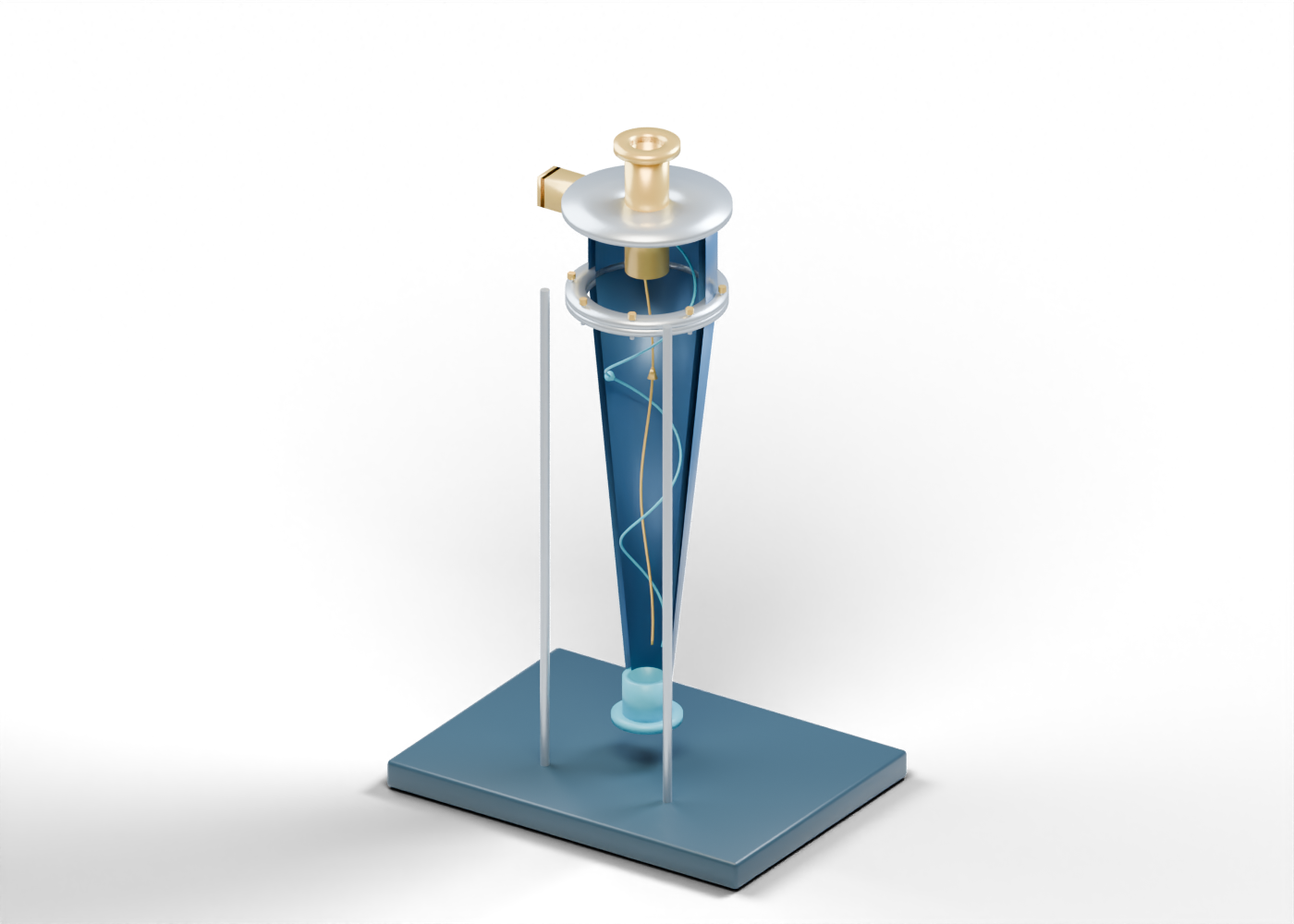
SLB's deoiling overview describes tangential entry, an oil-rich central region and water-rich flow near the liner wall. The original illustration has an open offset feed through the hollow inlet head. A separate long tapered liner exposes the narrowing path in a cutaway poster. Its invented proportions are not a supplier's liner design.
The blue outer direction cue and gold central direction cue are fixed visual lines. They are neither pipes nor a simulation of fluid motion.
3. Keep the two outlets distinct
The central reject finder leads to an open upper boundary. The lower water-rich outlet ends separately. The word treated describes the equipment role, not a verified effluent specification. The illustration does not show where the reject returns, which treatment follows, or whether either stream is eligible for a particular destination.
| Visible teaching element | What it helps identify | What it cannot establish |
|---|---|---|
| Offset feed | Arrival beside the upper head wall | Selected inlet pressure or actual swirl |
| Hollow taper | A narrowing geometric passage | Separation efficiency or erosion life |
| Central reject finder | A separate upper oil-rich boundary | Recovered oil quality or recycle route |
| Lower water outlet | A distinct water-rich boundary | Discharge, injection or reuse approval |
| Blue and gold cues | Two conceptual directions | Droplet trajectories or measured flow |
4. Read performance claims with their conditions
If a report gives an oil-removal percentage or an outlet concentration, look for the tested equipment revision, incoming fluid composition, pressure conditions, sampling points and measurement period. Supplier performance claims can describe a product family or test conditions; they do not automatically transfer to another installation. This original atlas model supplies none of those measurements.
Also distinguish a hydrocyclone from the dry gas-and-solids cyclone. Both use rotational separation vocabulary, but they address different streams and cannot be substituted based on similar silhouettes.
5. Follow water handling beyond the model
Produced-water handling depends on the actual contaminants, treatment sequence and applicable local approvals. The U.S. EPA's overview of oil and gas effluent guidelines defines produced water for its regulatory context; it does not establish an Alberta permission. This lesson gives no disposal, discharge, injection or operating instruction.
6. Explore each part
Open the interactive AlbertaOil hydrocyclone and select its feed, head, taper, two outlet boundaries and fixed path cues. Compare them with the separate oil-battery scene to see exactly where its water route stops. The original geometry illustrates roles; qualified review is still needed before using it as a technical reference for actual equipment.