1. Why use a progressing-cavity pump?
A progressing-cavity pump is one artificial-lift option used to move produced fluid from a well. A helical rotor turns within a stator; their relative geometry is central to the pumping principle. SLB's artificial-lift overview places this equipment among lift methods, and its progressing-cavity pump explainer describes the rotor-and-stator relationship. Those sources inform the broad lesson. No vendor art, CAD, dimensions, pump curve or product specifications were copied.
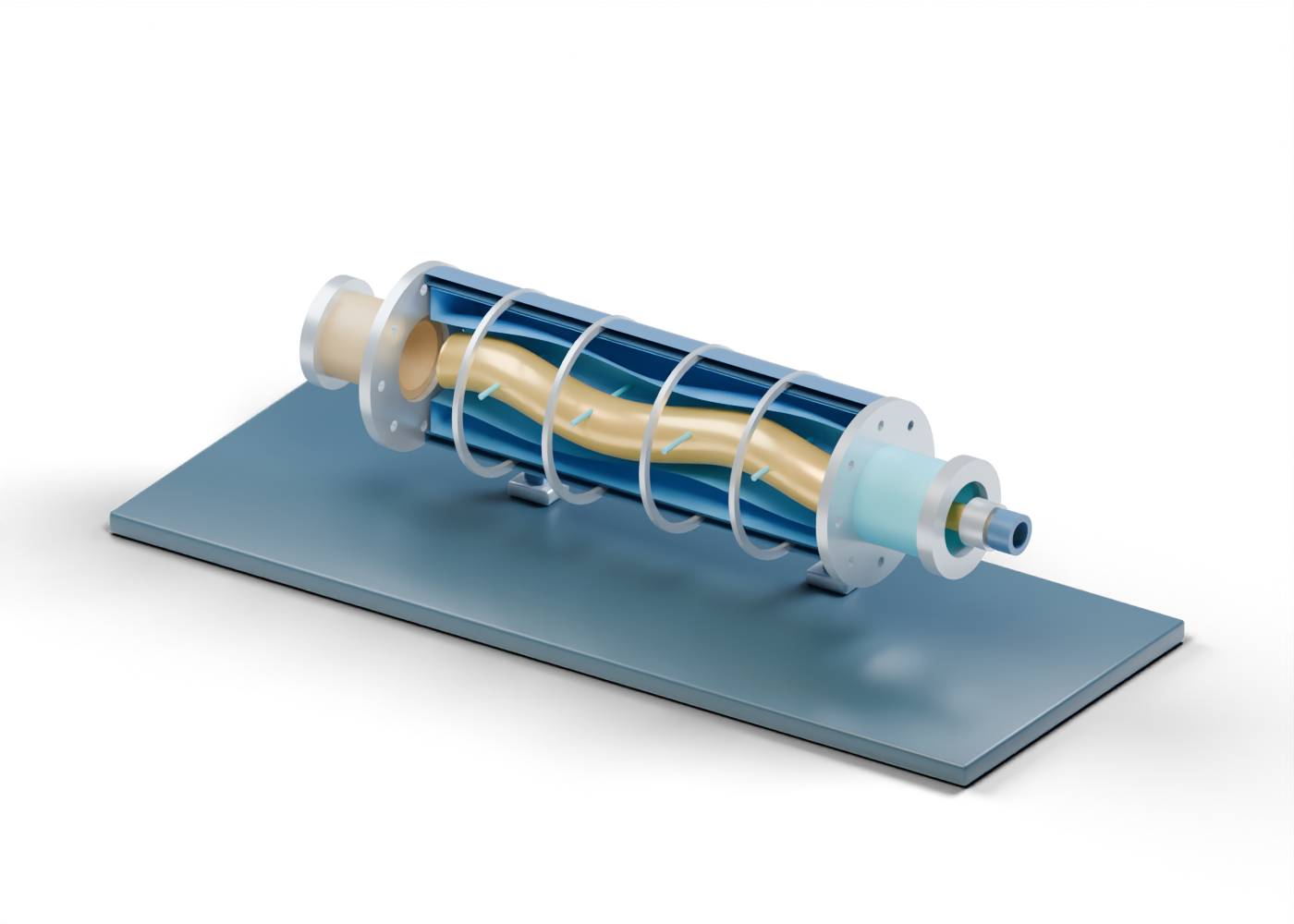
The original AlbertaOil 3D pump lesson uses 31 selectable parts. Its blue-and-prairie-gold poster sections the facing housing and stator liner so the rotor is visible; the interactive browser model retains their complete surfaces. The horizontal presentation makes the parts easier to read and does not depict a completed well.
2. Start at the intake boundary
The open produced-fluid intake sleeve and intake collar indicate where fluid could enter the illustrated pump assembly. They are genuinely open meshes, but no fluid is simulated. The intake bored end plate has a central bore and eight perimeter holes. That invented pattern helps distinguish an opening from a solid disc; it does not establish a real port layout or intake performance.
The complete steel housing wall encloses the teaching assembly. Its size, supports and wall thickness are invented. They are not an equipment rating or installation drawing.
3. Compare rotor and stator surfaces
Select the double-lobe stator liner and then the eccentric single-helix rotor. The liner has independently contoured inner and outer surfaces; the gold rotor is a separate solid mesh. Four static cavity-reading markers help point out a possible path through their relationship. They are fixed visual cues, not volumes of trapped or displaced fluid.
The model deliberately leaves clearance between the parts. It does not show a sealed contact line, elastomer deformation, rotation, pressure generation or a real pump's displacement. The US EPA's wastewater collection manual also describes the general helical rotor-and-stator principle in another service; that is context, not evidence that this scene is suitable for oilfield service.
| Teaching element | Helps locate | Does not establish |
|---|---|---|
| Open intake sleeve | Incoming boundary | Selected fluid or intake performance |
| Contoured stator liner | Stationary surrounding surface | Elastomer, interference fit or wear life |
| Eccentric helical rotor | Moving member's shape | Rotation, seal or pump curve |
| Four cavity markers | Places to discuss progressive cavities | Actual sealed volumes or displacement |
| Discharge sleeve and drive cue | Separate outlet and drive boundaries | Pressure, torque or completed rod string |
4. Trace the two outgoing roles
The open annular discharge sleeve marks a produced-fluid exit. The discharge collar remains an open boundary, not a check valve or verified connection. A separate static drive-rod extension and coupling envelope identify a drive-side relationship. No motor, rod string, speed or control system is operating here.
Four section-reference rings make it easier to find your place along the body. The display feet and end plates have real bores, but this is a visualization assembly, not a manufactured tool.
5. Compare other pumping lessons
The rod-pump lesson shows a different artificial-lift mechanism based on a reciprocating plunger and valves. The centrifugal-pump lesson helps compare impeller-based pumping. These models are independent educational scenes and do not rank the methods for a reservoir, fluid or completion.
A real selection requires fluid and well data, expected solids and gas, temperature, production targets, drive and torque analysis, equipment specifications and qualified review. Neither the poster nor these simplified 3D parts can support an operating decision.
6. Inspect the complete model
Open AlbertaOil's interactive pump atlas page and select the intake sleeve, stator liner, rotor, cavity marker, discharge sleeve and drive extension. The poster is a sectioned reading aid; the browser model retains the complete housing and liner. This is an original conceptual lesson, not a fabrication, maintenance or safety instruction.