1. Follow the whole-tailings stream
An AER-filed Horizon measurement plan describes one operator sending primary-separation whole tailings to hydrocyclones. The feed contains water, solids and residual bitumen; it is different from the middlings stream sent for further flotation. Begin with the separate primary-vessel underflow, then open the 56-part classification scene. The scenes have invented, unmatched proportions.
2. Find the real offset feed opening
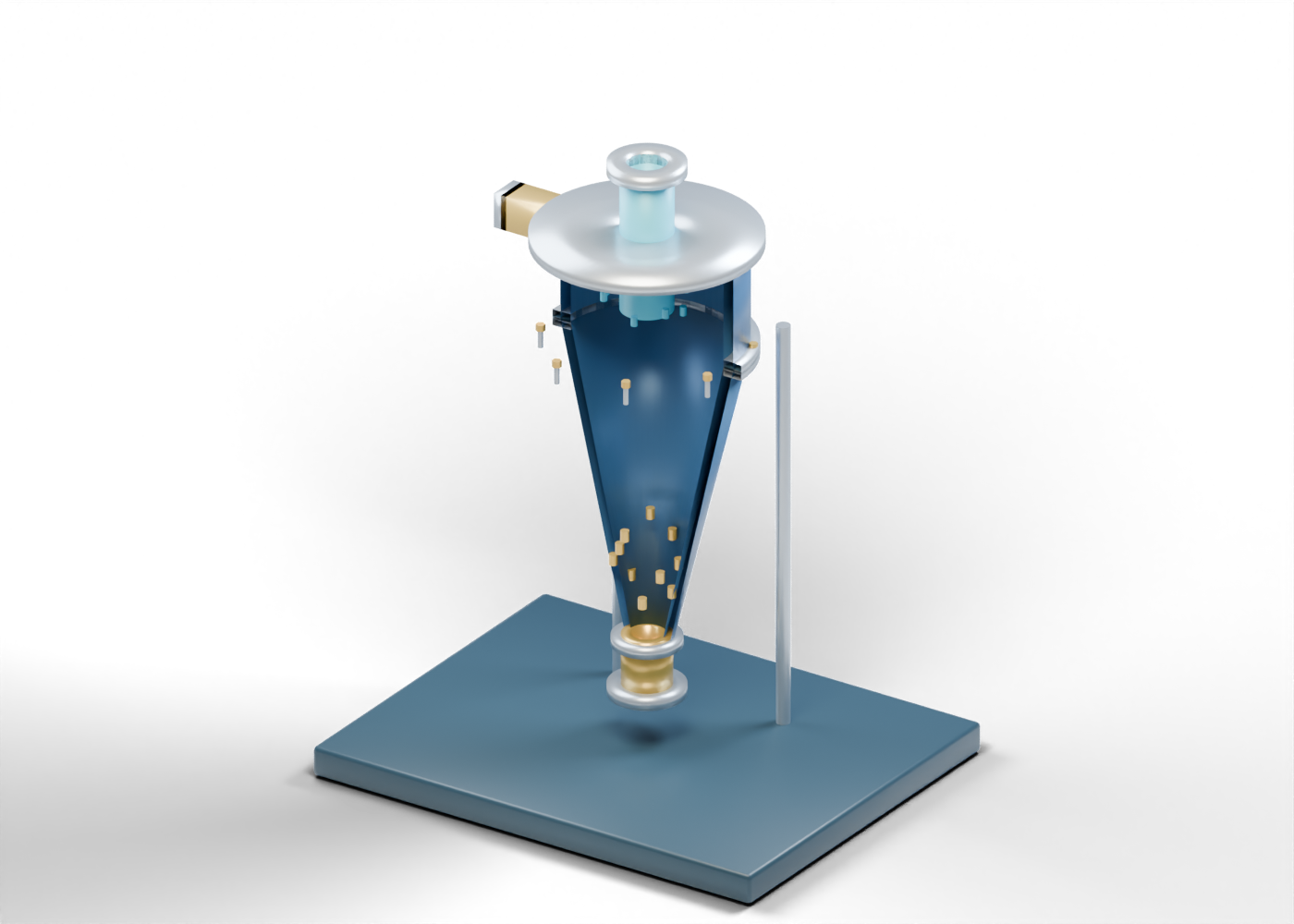
The whole-tailings inlet is a hollow duct crossing a genuine offset opening in the complete inlet chamber. The delivered model retains the chamber's full inner and outer walls. The still image cuts away a facing portion only so the openings can be seen. No feed pump, pressure, pipe size, liner or cyclone selection is specified.
3. Read the two exits separately
A general Metso wet-classification overview explains the underflow and overflow roles of a hydrocyclone. In the AER-filed Horizon account, the lower open apex represents a coarse-sand-rich underflow with less water and fines than the feed; the central upper finder marks the fines-and-water-rich overflow. This does not mean either stream is pure, dry or clean. The complete cone wall and both outlets are open teaching geometry, not a manufacturer's unit.
4. Separate cues from measured movement
The gold coarse-solids cue and blue fines-rich cue are stationary reading marks. They do not track particles or calculate a cut size, split, recovery or concentration. A joint location cue and display post help readers orient the object; neither establishes an installed seal, support or safe configuration.
| Visible element | Useful question | What the picture cannot prove |
|---|---|---|
| Offset feed | Where does whole tailings enter? | Feed rate or composition |
| Full chamber and cone | Which boundaries guide the lesson? | Actual cyclone size or liner design |
| Upper overflow finder | Where is the fines-rich outlet? | Water quality or solids split |
| Lower apex | Where is the coarse-sand-rich outlet? | Dry sand or final tailings handling |
| Static colour cues | Which region is being discussed? | Particle paths or measured performance |
5. Ask for the missing evidence
A classification claim needs measured feed and outlet samples, operating conditions, the size distribution and a defined calculation period. This model supplies none of those results. The cited plan describes one operator; it does not authorize a different project's equipment, water reuse or tailings disposal. The separate produced-water deoiling guide concerns another duty: removing oil from produced water, rather than classifying whole-tailings solids.
6. Continue to the thickening question
In the Horizon account, the fines-rich cyclone overflow moves toward thickening. Explore the independent tailings-thickener model and OilNews thickener guide to compare the later settling role. Flotation residue is another described thickener feed; it must not be confused with cyclone overflow. The links connect educational questions, not a matched process train or operating instruction.
For a cross-model view, use the six-stop AlbertaOil visual study to compare all five independent original equipment models, open exact parts, and keep whole-tailings classification distinct from the middlings-flotation question. The reading map is not a matched facility or operating route.